

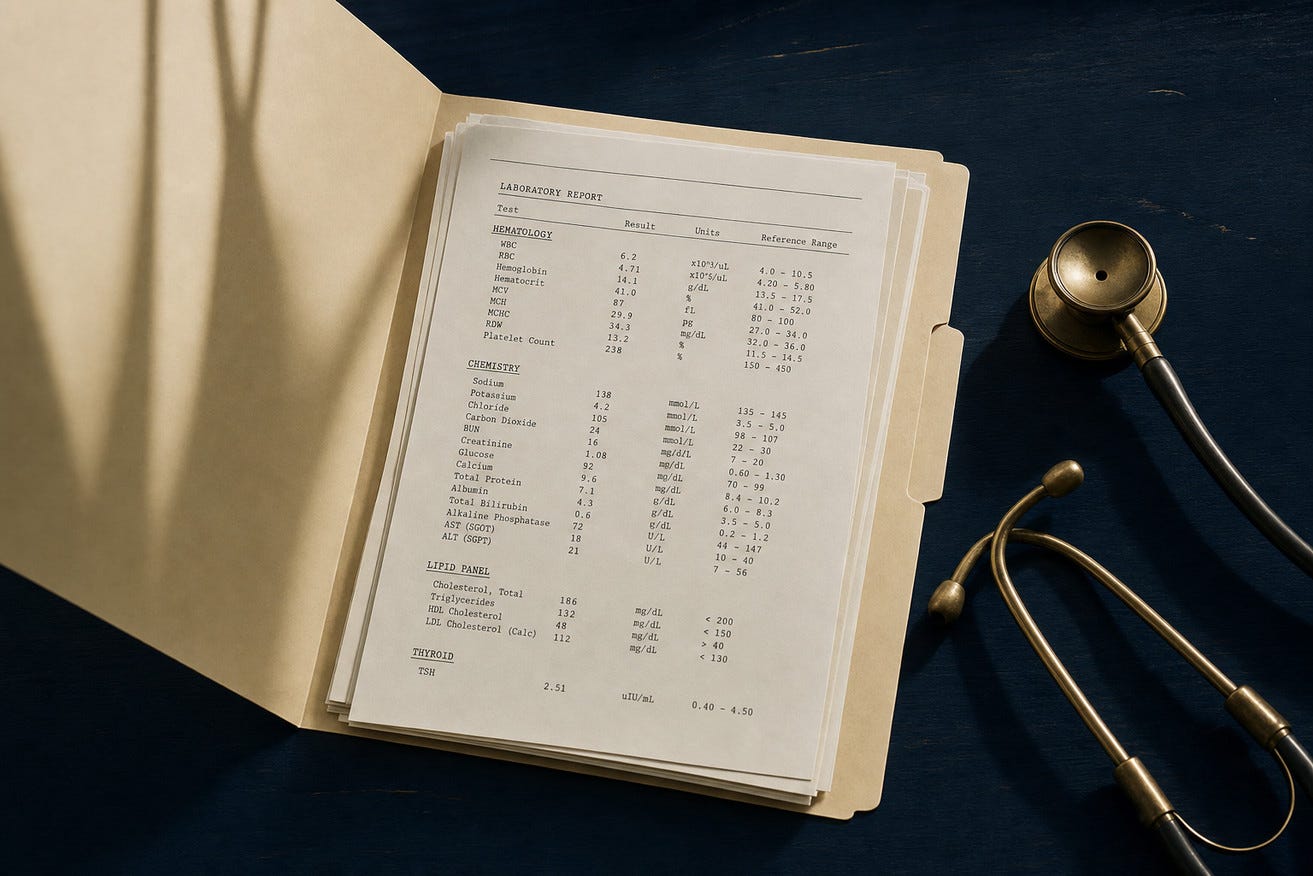
Meera walked into my clinic with a folder.
Not a phone. Not a wellness app. A manila folder, organized by tab, with five years of lab reports in chronological order — the kind of preparation you do when you’ve been dismissed before and you’re determined not to be dismissed again.
She was forty-four. She worked in healthcare administration. She knew the language. She’d chosen her words carefully: fatigue, brain fog, weight that wouldn’t move despite a caloric deficit she’d tracked to the gram. She was not dramatic about it. She handed me the folder the way you hand someone evidence.
Every marker inside was normal.
CBC, comprehensive metabolic panel, lipid panel, TSH, free T4, fasting glucose. Her internist had ordered a full workup eighteen months earlier. Her gynecologist had checked hormones six months after that. Both had told her what the data said. Her internist handed her a pamphlet on sleep hygiene and suggested she consider therapy. Her gynecologist noted she was perimenopausal, offered an antidepressant, and told her the fatigue would likely improve.
Meera had declined both. She was not sleeping poorly because she lacked good habits. She was not depressed in the way a prescription would fix.
She left those offices the way patients leave when the system has processed them but not heard them.
She went to the wellness industry next. Of course she did. The system left a gap, and something moved in to fill it. She spent fourteen months and somewhere near four thousand dollars on a functional medicine clinic that ran ninety-two labs, flagged seventeen “subclinical” findings, and put her on eleven supplements. She felt better for eight weeks. Then she didn’t. She spent another two thousand on a program that reset her nervous system through breathwork, cold plunge, and infrared sauna. The program was not wrong, exactly — the biology is real. But it did not ask the question underneath the question.
She came to me carrying both failures. One system told her nothing was wrong. The other told her everything was wrong, for a price. She was exhausted by both.
Good labs. Bad life. There’s a reason.
I asked Meera something her previous physicians had not asked. I asked what her life looked like — not her schedule, but her life. What she had traded, over the years, to remain functional. What she had stopped reaching for. She paused for a long time. She said, “I manage everything. I just don’t feel like myself anymore.”
That sentence. I have heard some version of it from hundreds of patients in their forties and fifties. It is not depression’s language. It is not burnout’s language exactly, either. It is something more specific — the recognition that her life had stopped feeling like the person living it.
The conventional medicine system had no code for that. The wellness industry had a protocol for it: regulate the cortisol, replenish the adrenals, reset the nervous system. But those are downstream moves. They address the signal, not the source.
The body does not malfunction. It escalates. What Meera was experiencing was not her biology failing her — it was her biology loyally executing a set of instructions that had once served her: high output, low rest, emotional compression, forward motion at all costs, until the cost finally exceeded what the system could absorb.
Her HPA axis was dysregulated, her cortisol curve flattened, her hsCRP sitting at 1.7 — not alarming, but not nothing — and underneath all of it, a sleep architecture problem that wouldn’t register on a standard TSH and sluggish phase 2 liver detoxification that no one had thought to look for. These are real, measurable findings. They are also downstream.
Upstream was a three-generation story of women in her family who had learned to disappear competently. Her mother. Her grandmother. The art of being indispensable and invisible at the same time.
That contract doesn’t live in memory alone. It lives in the cortisol rhythm, the immune set point, the body’s willingness to keep spending what it no longer has.
Biology is not just biochemistry. It is biography. What gets inherited gets encoded, and what gets encoded runs until someone in the lineage stops and reads the receipt.
I did not tell Meera to start meditating. I did not add an eleventh supplement. I ordered two labs her internist had not ordered: a DUTCH complete hormone panel and an organic acids test. I asked her to do one thing before our next appointment — to write down three things she had stopped doing in the last five years, not because she had to stop, but because she simply had. She looked at me like I had asked her a strange question. That reaction is data too.
When she came back, the list had seven items on it.
We started there.
Meera is six months out from that appointment. Her hsCRP is 0.9. Her cortisol rhythm has normalized. She is sleeping six and a half hours, up from five. But that is not the part that matters most to her. The part that matters is she took a ceramics class. She had not made anything with her hands since her twenties. She does not frame it as healing. She calls it remembering.
I am not the reason for that. I just asked the right question at the right time. That is, in the end, what the medicine I practice is for.
Dr. Shiv Kumar Goel is a board-certified physician practicing internal, functional, and aesthetic medicine in San Antonio, Texas. He is the founder of Prime Vitality Care and TimeVitality.ai — an AI venture bridging East-West medicine with precision diagnostics. He is the author of the forthcoming book Healing the Split: When Your Biology Is Fighting Your Biography, and hosts the Vitality Matrix podcast. His work appears in KevinMD, Op-Med, Medium, Elephant Journal, and San Antonio Medicine.
The patient in this essay is a composite drawn from clinical encounters over many years of practice. All identifying details — name, age, occupation, timeline, and circumstance — have been modified. No individual patient is depicted or identifiable