

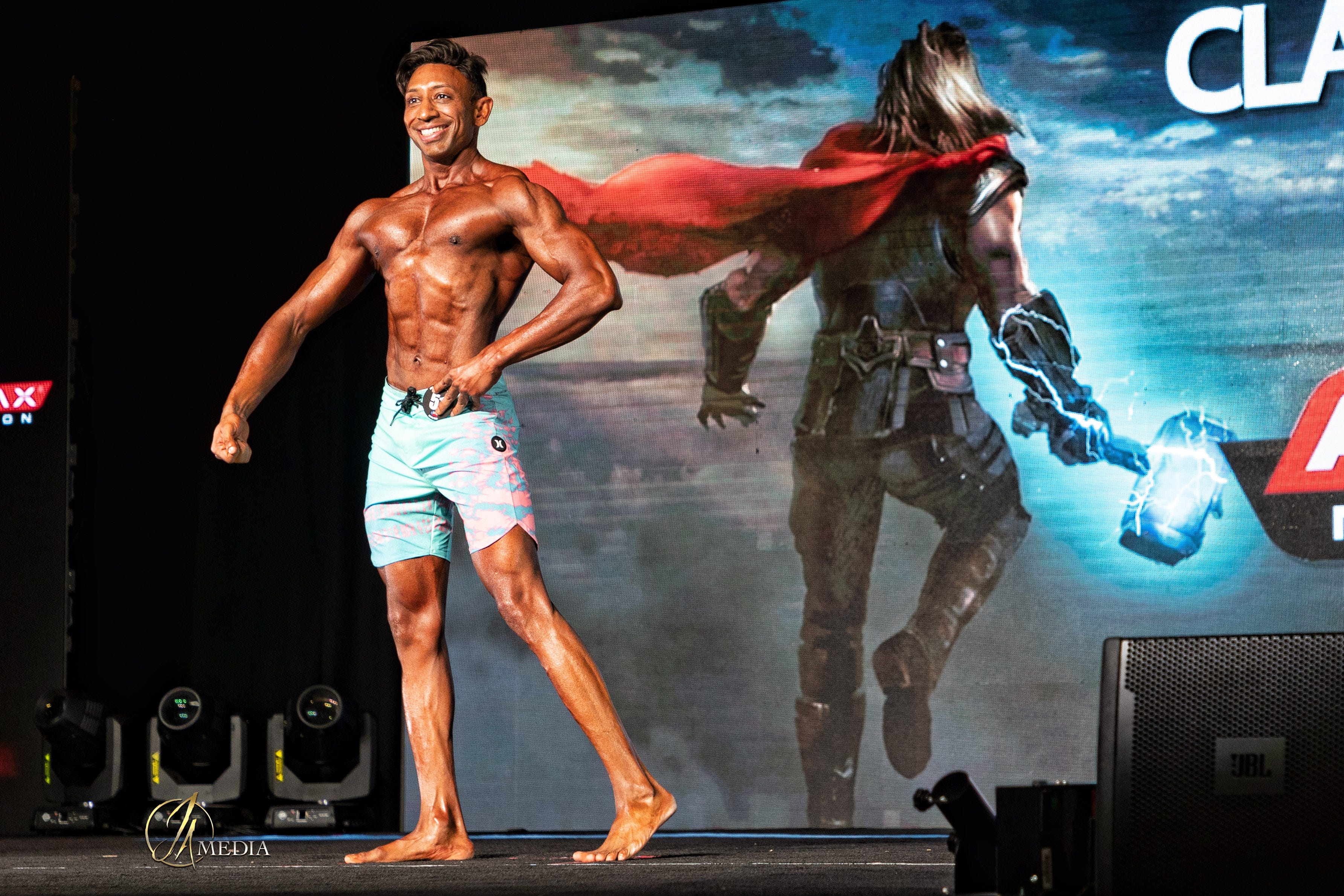
My middle back tightened before I finished the pose.
Then my traps began to cramp.
They had already been inflamed. Under the stage lights, they would not open the way I had practiced. During the two minutes for which I had trained for months, my body could not make the shape I had taught it to make.
I knew what the failed pose could cost.
I believed it kept me from winning the Open division.
I won Masters and placed third in Open. I was proud of that result. I still believed the cramp had cost me first place.
But something else mattered more during those two minutes.
The one thing I had focused on most had somehow lost its purpose.
I was 45 when I entered the bodybuilding competition.
I had practiced medicine for two decades. I had ordered thousands of laboratory panels. I had advised patients about exercise, nutrition, sleep, hormones, and recovery.
None of that made me the expert backstage.
I was there to be judged on what the body could show.
Muscularity. Symmetry. Leanness. Presentation.
The visible result of months spent training, eating with precision, protecting recovery, and repeating the work when progress appeared absent.
I respected that work then.
I respect it now.
Resistance training is real medicine. The 2026 American College of Sports Medicine position stand synthesized 137 systematic reviews involving more than 30,000 participants. Resistance training improved strength, hypertrophy, power, balance, gait speed, and several measures of physical function.
The same position stand made another point worth protecting. Programs should fit a person's goals and enjoyment. Complexity matters less than a plan a person can sustain.
Bodybuilding placed me inside the prescription I had given others.
I learned how slowly a body can change after 40.
I learned that effort does not guarantee a result on schedule. A flawless week does not always produce a visible improvement. One mistake does not erase months of work.
That experience changed how I listened to patients.
When someone told me they had followed a plan without seeing progress, I heard more than the stalled number. I heard the early mornings, the declined meals, the doubt, and the decision to continue.
For a long time, I believed that was the competition’s most important lesson.
Strength meant showing up.
It meant returning when the result did not reward you. It meant accepting that biology does not move according to motivation.
That remains true.
It was also incomplete.
At first, the competition gave my discipline a clear direction. It asked me to test what was possible at an age when many people begin accepting less from their bodies.
Training gave me structure.
Preparation made me more patient.
The stage required me to enter a room where I was not the authority.
Those were real gifts.
But a serious pursuit can change without announcing that it has changed.
A goal may begin by serving the person. Somewhere along the way, the person may begin serving the goal.
Food served the stage.
Sleep served the stage.
Recovery served the stage.
Even the mirror became less a place to see myself than another instrument of correction.
I kept chasing the next improvement.
More definition. Better symmetry. Greater control. Fewer mistakes.
Perfection kept moving farther away. I kept assuming the answer was greater precision.
That is what I began to see during those two minutes.
My middle back was tight. My traps were cramping. I could not open the pose I had practiced most.
Part of me immediately calculated the consequence.
I might have lost first place.
But another part of me recognized something harder.
The constant chasing had begun producing the opposite of what I believed I was building.
I had called it strength because I could tolerate more.
More training. More hunger. More precision. More pressure.
But carrying too much was not strength.
It was making me too weak to admit what the carrying cost.
Carrying too much was not strength. It was making me too weak to admit what the carrying cost.
That distinction reaches beyond bodybuilding.
Medicine can measure strength through force, muscle mass, mobility, and function. Those measurements matter. They help us understand whether someone can climb stairs, recover balance, lift an object, or remain physically independent.
They cannot tell us what that strength is serving.
One person trains because strength expands freedom.
Another trains because the next achievement has become proof that the previous one was not enough.
The exercise may look identical.
Its purpose may not be.
I had treated strength as the capacity to carry more.
I had not asked whether carrying more was always the right use of that capacity.
I had not asked when the pursuit had stopped training my system and started feeding my ego.
That question does not make ambition dangerous.
It does not make discipline a symptom.
It does not mean the cramp contained a message or that biography explains every physical event. My back and traps had been placed under prolonged physical demand. The cramp was physical.
But physical events happen inside lives.
The cramp did not explain my life.
It interrupted the performance long enough for me to question it.
What was all this strength serving now?
My biology had not turned against me.
It had followed the plan.
It followed the preparation, the repetitions, and every additional demand. It adapted to the biography I believed I was building correctly.
Until I could no longer ignore the cost.
That is not betrayal.
It is the limit of adaptation.
The mistake was mine. I had confused my body’s capacity to adjust with evidence that every demand deserved to continue.
Since when had strength meant carrying everything?
Strength is capacity used when capacity is needed.
It is not diminished by admitting a limit. Sometimes that admission is what preserves the capacity we still have.
Discipline remains valuable.
It brought me to that stage. It taught me patience. It changed how I speak to patients whose bodies have not responded on schedule.
But discipline needs direction.
Otherwise, it becomes excellent execution in service of a purpose that has already disappeared.
The trophy still matters to me.
It marks the preparation, the hunger, and the decision to enter a room where I was not the expert.
It also marks the limit of what performance can establish.
I went onstage to present the most finished version of my body.
My back would not open.
I lost the pose I had practiced most.
Perhaps it cost me first place in Open. That still matters.
But something more lasting happened during those two minutes.
The pursuit no longer got to define strength by how much I could endure.
I had built a body capable of carrying more.
I began asking whether everything I carried still deserved my strength.
Sources: American College of Sports Medicine, Resistance Training Prescription for Muscle Function, Hypertrophy, and Physical Performance in Healthy Adults: An Overview of Reviews. Medicine & Science in Sports & Exercise, 2026.
I write Healing the Split for people who are strong in every way that shows and tired in ways that don't. Subscribing is free, and it's how the next essay finds you.
If someone you love keeps proving they can carry more, send this to them.
What are you still carrying that no longer deserves your strength? Tell me in the comments. I read them.
Dr Shiv Kumar Goel is an internal medicine and functional medicine physician and founder of Prime Vitality Care in San Antonio. Across 25 years in hospitals, intensive care, and functional medicine, he has studied the gap between what medicine can measure and what patients actually live through. He writes Healing the Split and is the author of the forthcoming book The Unread Life.