

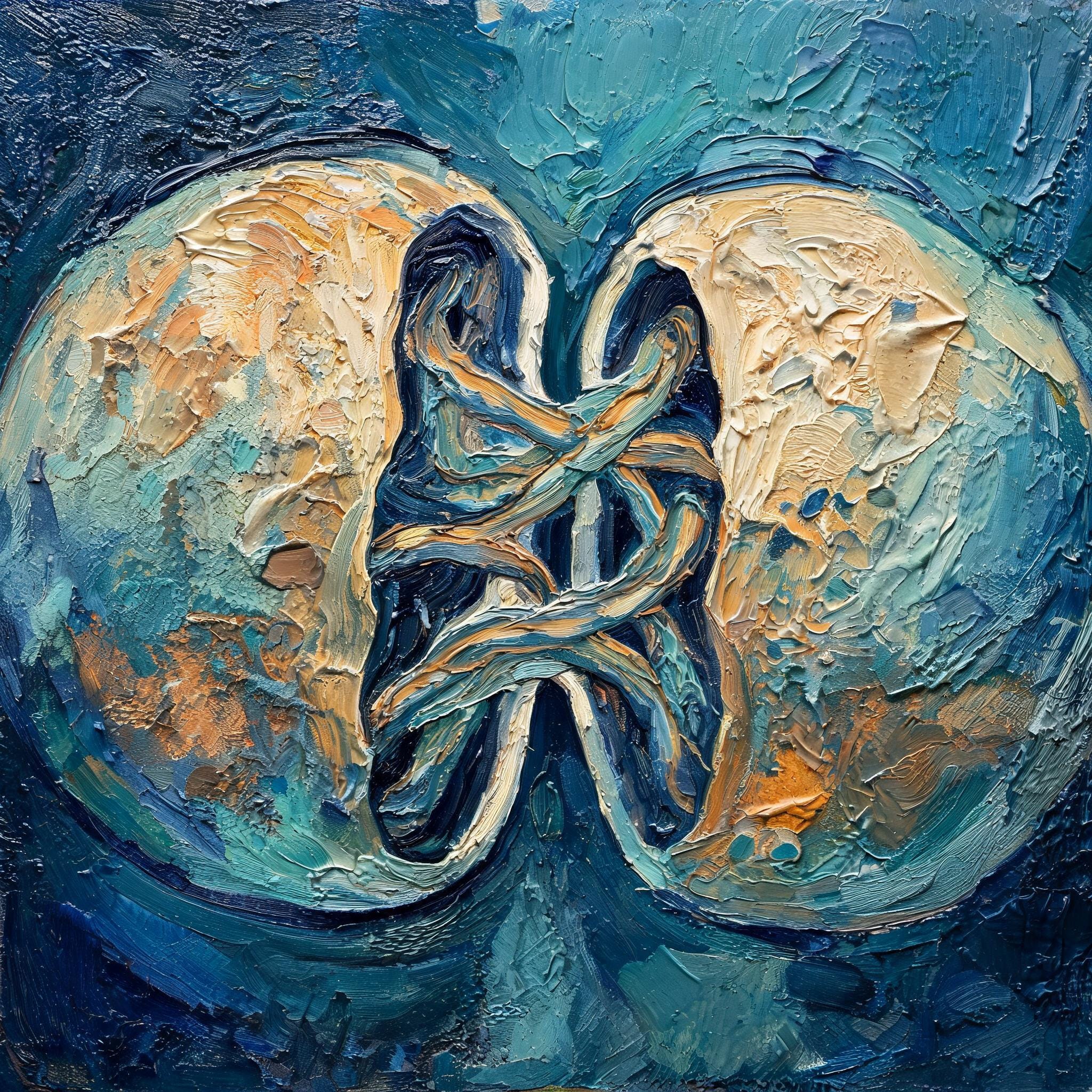
There is a moment most of us know intimately, though we rarely name it. Someone asks something of us—our time, our agreement, our presence—and we say yes while everything inside us says no. The yes comes out smooth and warm. The no stays where it has always stayed: underground.
If you have been doing this work for any length of time, you have probably learned to call this a split. The performing self and the feeling self. The one who shows up and the one who got left behind. And somewhere along the way, you have likely absorbed the idea that this split is the problem. The defect. The thing to be eliminated.
I want to offer a different starting point, one grounded not in psychology, but in biology: the split was originally intelligent.
The Body’s Ledger
Think back to when the division first formed. For most of us, this is not a single dramatic moment but a slow accumulation of lessons. Anger made someone leave the room. Sadness made someone uncomfortable. The message arrived in a hundred small deliveries: some of you is welcome here, and some of you is not.
A child cannot survive that message by arguing with it. A child survives it by complying—by keeping the unwelcome parts out of sight.
And here is the thing we forget when we declare war on our own divisions: the adaptation worked. You are here. You made it through. The split that now frustrates you was once the most sophisticated protection available to a person who had very few options.
The split is not evidence of your brokenness. It is evidence of your ingenuity under conditions you did not choose. But the body keeps the ledger of everything unsaid. The adaptation does not stay in the mind; it writes itself into the tissue.
Why Demolition Fails
This matters practically, not just philosophically, because the stance we take toward the split determines whether healing is possible at all.
When we treat the split as an enemy, we approach it the way we approach any enemy: with force, with judgment, with the intention to destroy. We try to make ourselves authentic—a contradiction so complete that the effort defeats itself.
The nervous system registers this effort exactly as it has always registered a threat. It tightens. The physiological state of sustained defense remains active. You cannot bully a nervous system into standing down. You can only convince it that the danger has passed.
Renegotiation, Not Removal
What actually changes things—slowly, undramatically, the way real change moves—is approaching the split from a third position: gratitude for the protection, honesty about the cost.
Not gratitude as performance. Not “thank you, now please leave.” Something closer to the gratitude you might feel toward a biological system that has been running a stress response for thirty years because no one ever told it the war ended. There is respect in that recognition. There is grief in it too—for how long the post was held, and for what the holding cost in fatigue, in inflammation, in a life lived at a fraction of its capacity.
From that stance, a different kind of conversation becomes possible. Instead of why are you malfunctioning, we can ask: what were you protecting me from?
The nervous system does not surrender to this conversation; it softens into it. The split does not vanish. It becomes permeable. The no that lived underground starts to surface in small, survivable ways: a pause before the automatic yes, a sentence spoken slightly closer to the truth, a physical sensation allowed to stay in the room thirty seconds longer than it used to.
This is what integration actually looks like from the inside. Not a wall coming down in one cinematic moment, but a physiological shift from defense to safety.
A Question to Sit With
So today, instead of asking how do I get rid of my split, try asking the older, kinder question:
What was this division protecting, and what did the protection cost?
Both halves of that question matter. The first honors the biological intelligence of the adaptation. The second honors your right to want something more than survival now.
The split is not your enemy. It was your biology loyally following your biography.
Subscribe to Healing the Split
Join a community exploring the space where modern medicine ends and the rest of the body’s intelligence begins. Free weekly essays on the physiological cost of the lives we survive, and the science of coming home.
About the Author
Dr. Shiv Kumar Goel, MD, is an internal medicine physician in San Antonio, Texas, trained at Mount Sinai, and the founder of Prime Vitality Care. He is the author of the forthcoming book The Unread Life.
Your insightful story, which goes beyond biology, gives us a unique, more humane, and optimistic perspective on our defects through powerful metaphors and inherent wisdom. Thank you for writing this heartfelt and educational story, Dr Goel. It deeply resonated with me.
I loved your well crafted and heartfelt story which spoke to me. Well done!