

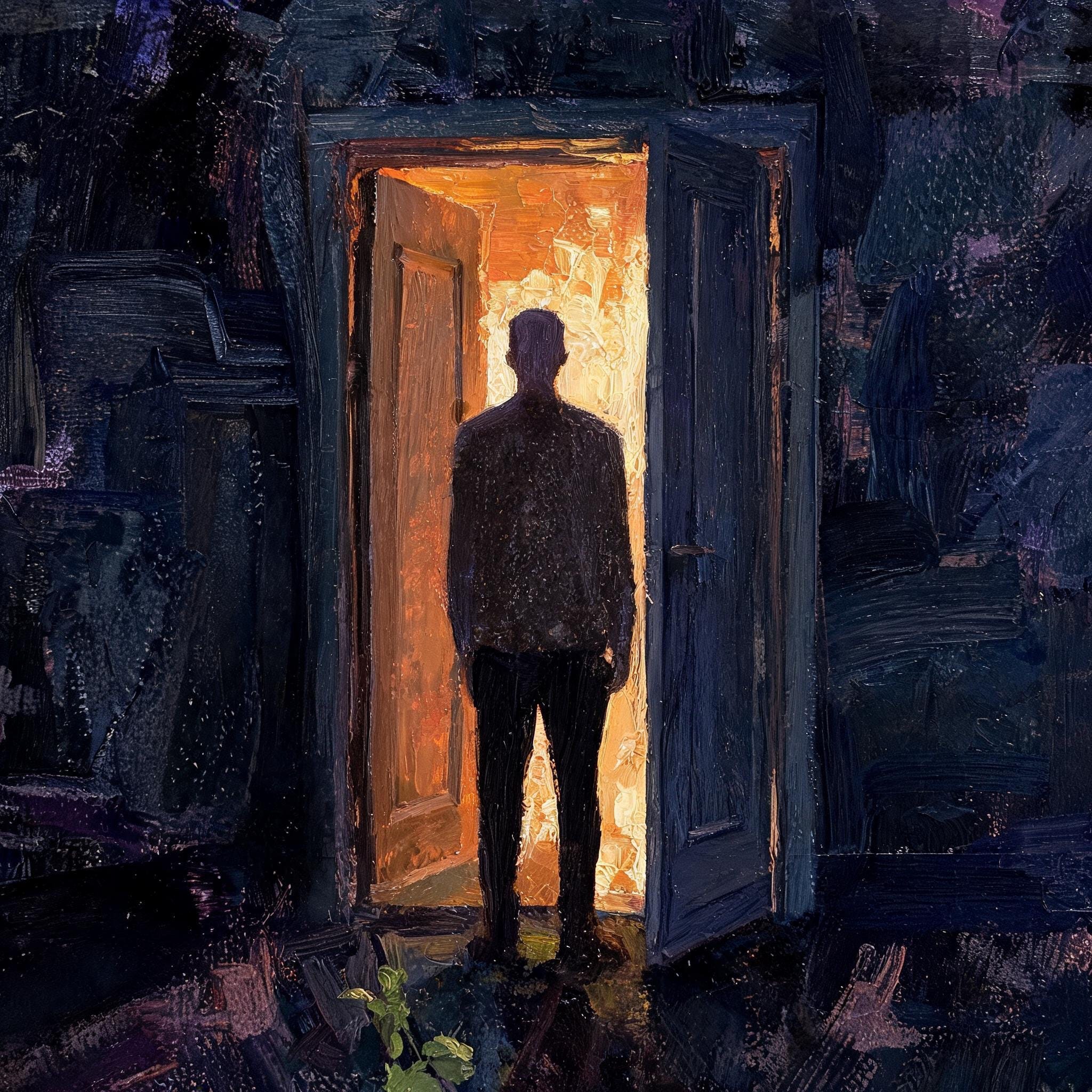
One day you wake up. Same walls. Same ceiling. Same people.
But something has shifted.
The place you have been calling home — you see it now as a cage.
Not because it changed. Because you did.
This is the moment no one warns you about. They talk about the breakthrough. The awakening. The turning point. They make it sound like freedom arrives with applause.
It doesn’t.
It arrives as a quiet, disorienting terror. The walls look the same. Your name is still on the door. The people inside still love you in the only way they know. But you can see the bars now. And once you see them, you cannot unsee them.
I have sat with this in my own life. I have watched it in patients.
The physician who has been practicing for twenty years and realizes she has been practicing someone else’s medicine. The son who has run the family business for a decade and wakes one morning knowing he was never meant to be there. The woman who has kept everything together and suddenly cannot explain why the keeping together feels like it is slowly killing her.
Good labs. Bad life. There’s a reason.
The reason is not weakness. It is not ingratitude. It is not crisis.
It is biology finally saying what biography never let you say.
The ones who feel caged do not become more caged when they start to see clearly. They were always caged. The clarity is not the problem. The clarity is the beginning.
The guards at the door — the ones who tighten their grip the moment you start asking questions — they are not your enemies. They are loyal to the only architecture they have ever known. Your seeing threatens their certainty. That is not malice. That is fear wearing the mask of care.
The reformers — the ones who arrive with the language of liberation and offer you a newer, cleaner cell — they are the most dangerous. Learn to feel the difference between the one who opens the door and the one who just moves it.
Here is the harder truth.
The prison was not built by your enemies. It was built by people who lived inside one too. They handed it to you as shelter. They called it home because it was the only home they had.
They created the split. You carried it without knowing.
This is what breaks open when I sit with a patient who is doing everything right and still feels like a stranger in their own life. It is not their failure. It is an inherited structure. The body is doing what biography asked of it — loyally, faithfully, until it cannot anymore.
The body does not malfunction. It escalates.
Not everyone who sees the prison wants to leave.
I want to be honest about that.
[Patient composite — all identifying details modified]
A man I’ll call Dev is in his late fifties. Spent his career in a demanding field that ran on hierarchy and protocol — you followed the chain, you did not question it. He came in a few months ago for insomnia. His wife had just passed. Over two decades together. No children.
I have known him for a while.
He is not a man who questions the architecture around him. He followed the rules. He built the life he was told to build. His wife, in her own quiet way, agreed with everything — which did not give him a mirror. It gave him an echo.
Now she is gone. And for the first time in his life, no one is telling him what to do next.
He told me his life is over.
He is on antidepressants. He is seeing a therapist. We are doing what the situation calls for.
But sitting with him, I heard something underneath the insomnia, underneath the grief. He is not lost because she died. He is lost because the warden just left.
The prison is all he has ever known. The walls are the only grammar he has for the word home.
I did not try to show him the door.
Some people are not ready for it. Some people, at this point in a life, need the walls to still be there. To take that from him — in the name of liberation — would be its own kind of violence.
I listened. I renewed his prescription. I told him to come back.
That is also medicine.
Out beyond ideas of wrongdoing and right doing,
there is a field.
I’ll meet you there.
— Rumi
So how do you leave, when you are the one who is ready?
Not by breaking harder. The more force you bring to the bars, the more the structure tightens around the force. That is not a metaphor. The HPA axis reads threat. The nervous system braces. The biology follows. You cannot heal in a body that is still bracing for impact.
You leave the way water leaves — through the crack that was always there.
The way of the whisper, not the shout. The inner knowing that was never lost. Only silenced. Only buried under the noise of the biography you were handed.
You never needed the map. You have the GPS built inside each fabric of yours.
The world outside does not reward you for leaving. No parade. No applause. For a while, the ones you love most will not understand. They may resist. They may grieve the version of you that stayed.
That is not your failure.
It is the natural consequence of becoming more clearly yourself in a space that was built around a smaller version of you.
I don’t know where you are reading this. Maybe at midnight. Maybe in the car after a long day when the house felt too quiet and too full at the same time. Maybe on a Sunday night when the weight of the week ahead feels like it belongs to someone else’s life.
But I know this.
The fact that you can see it — really see it — is not the problem.
It is the way.
The body has been waiting a long time. This is the first time you agreed to look.
Dr. Shiv Kumar Goel is a board-certified physician practicing internal, functional, and aesthetic medicine in San Antonio, Texas. He is the author of the forthcoming book Healing the Split: When Your Biology Is Fighting Your Biography. He writes at healingthesplit.com.