

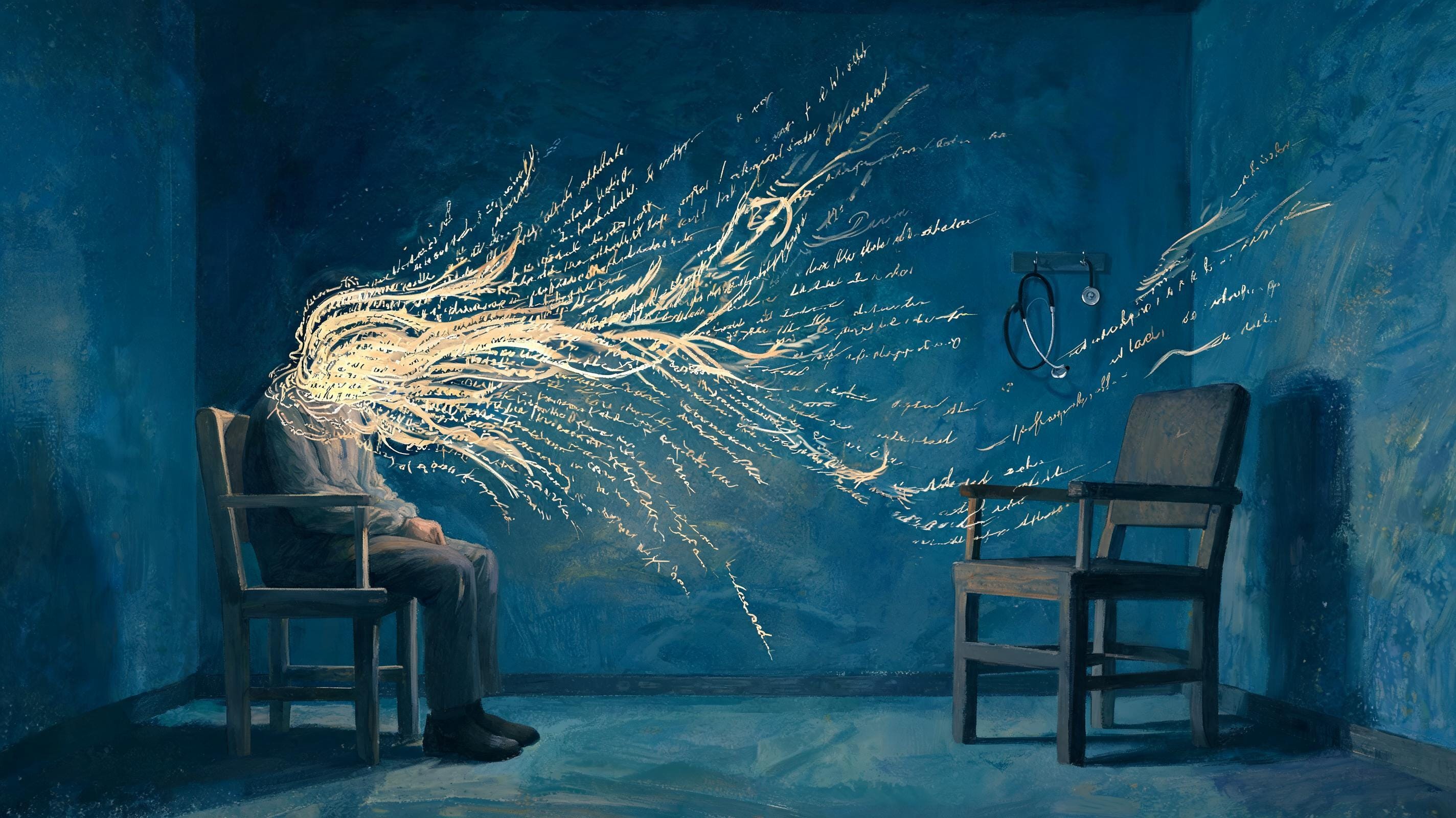
She came for peptide therapy.
That was the request. Reverse the aging. Fix the joints. She had done her research — the way she did everything — thoroughly, fluently, with full command of the literature.
She mentioned the zoledronic acid almost in passing. Mild osteoporosis, she said. Some side effects. She said it the way she said everything. Like a fact that had already been processed, already filed.
I wrote it down.
Because when someone accepts that much intervention for that little disease, the question is almost never about the bones.
She came in with a folder.
Not a physical folder. The folder was in her mind. Every tab labeled. Every section indexed.
Insomnia. Anxiety. Always at the edge. The need to look perfect. She named them the way a cardiologist names leads on an EKG — precisely, without flinching.
She had an OB-GYN, a dermatologist, a PCP, an endocrinologist, and a therapist. Five physicians. Five separate conversations about five separate pieces of the same person.
She had done the work. She had read the chapters. She had named the inheritance.
“I’m probably a carbon copy of my mother,” she said. Then, almost in the same breath: “We haven’t spoken in a while.”
She said it flat. Not grieving. Not angry. Reported.
The way you report a fact you stopped feeling a long time ago.
The mother was not easy. Anxious. Always at the edge — the same edge. The same nervous system, passed forward without anyone choosing to pass it.
The father was there. Physically. But not really there.
She described him in six words: “Yeah, we are just not that close.”
No catch in her voice. No pause. Just the flat geography of a distance she had stopped trying to cross.
She is single now. Her children live in different states.
She knew the pattern. She just hadn’t let it touch her yet.
She talked in full paragraphs.
No searching for words. No visible confusion. She anticipated questions and answered them before I could ask. She knew the clinical language. She knew the generational thread. She knew what the body does when it grows up inside a nervous system that never learned to rest.
She knew everything.
And somewhere in the telling and the telling and the telling, she had stopped hearing it herself.
I felt it clearly in that room. She had been telling her story to everyone. But not really hearing it deeply enough to understand.
That is what I sat with.
The story was not the problem. The story was correct. The problem was that the story had become the container — and the container had become the limit.
She was narrating her life from just far enough above it that she could not feel the ground.
I noticed something I rarely notice. There was no silence in that room. Not one pause she didn’t immediately fill. Not one question she left open.
She was talking faster than the silence.
And I did not know — sitting there — if she would ever let one in.
This is the gap medicine almost never names.
Not the gap between symptoms and diagnosis. Not the gap between what a patient feels and what the labs show.
The gap between accurate self-knowledge and actual change.
She could narrate the inheritance. She could trace it one generation back, two generations back. She knew the word epigenetic. She understood what chronic vigilance does to the HPA axis. She had the map.
Your symptoms are not random. They are your biography written in your biology.
But knowing the biography is not the same as rewriting it.
The body doesn’t keep score of what you understand. It keeps score of what you feel.
I want to be honest about the peptide request.
I prescribe these therapies. I use some of them myself. They are real molecules with real biology. This is not a story about a patient who was wrong to ask.
It is a story about sequence.
She wanted to reverse age. Fix the joints. Restore the surface. She had already done this with everything else — a specialist for each piece, a molecule for each complaint, a framework for each pattern.
Each piece in its own box. Each box handled. None of them adding up to a person who could sit in a quiet room without filling it.
She did not need another molecule before she had one room in her life where she could stop performing the knowing.
That was the upstream. And the upstream is always where the answer lives.
I did not tell her this in those words.
I ordered labs. I reviewed the zoledronic acid — it was, in my view, more intervention than her bone density warranted, and I said so carefully. I asked one question she had not been asked before. I do not know if she heard it.
She left with a plan. It looked, on the surface, like most of what she had been given before. The difference was not in the complexity.
It was in the question underneath.
Can’t help the one who doesn’t want to be helped. I have felt that before. But she came. She kept making appointments. She is still walking through doors.
People who have truly stopped looking do not do that.
I want to say something to the physicians reading this.
We have built extraordinary tools for naming what is wrong. Better imaging. Smarter biomarkers. More precise pharmacology. We have almost no practice for what to do when a patient already knows what is wrong — and has learned to use that knowing to stay exactly where they are.
Insight is not always the door. Sometimes insight is the lock.
And for the reader who sees themselves in her:
If you have told your story many times and nothing has changed, the problem may not be that no one is listening.
It may be that you have learned to talk just fast enough to stay ahead of the silence.
The work is not to explain your life better.
It is to risk one room where you stop explaining — and let your body answer back.
All identifying details have been modified.
Dr. Shiv Kumar Goel, MD, is an internal medicine physician in San Antonio, Texas, trained at Mount Sinai, and the founder of Prime Vitality Care. He is the author of the forthcoming book The Unread Life.