


She used the word failure the way some patients use the word diagnosis—as if someone with more authority had already confirmed it. She had lost forty pounds on Ozempic. She regained all of it in eleven months, the same month her insurance stopped covering the prescription.
She didn’t say her coverage lapsed.
She said she failed.
I didn’t correct her right away. Corrections land differently when someone finally hears themselves say the wrong thing out loud, in a room where another human being is prepared to disagree.
This is not an argument against the drug. Ozempic, Wegovy, Mounjaro—GLP‑1 receptor agonists—are among the most effective tools medicine has produced in decades. I prescribe them often. I will continue prescribing them.
The molecule is not the problem.
The problem is everything we never built around it.
The Silence No One Warned Her About
On paper, she did exactly what the drug is designed to do. GLP‑1 agonists act on receptors in the hypothalamus and hindbrain—the regions that register fullness and food reward long before conscious willpower gets a vote.
Her labs were pristine. Fasting glucose, A1c, lipids—textbook. The scale moved forty pounds in the right direction. By every metric medicine is trained to track, this was a success story.
But her labs never captured what stopped the moment the drug started working.
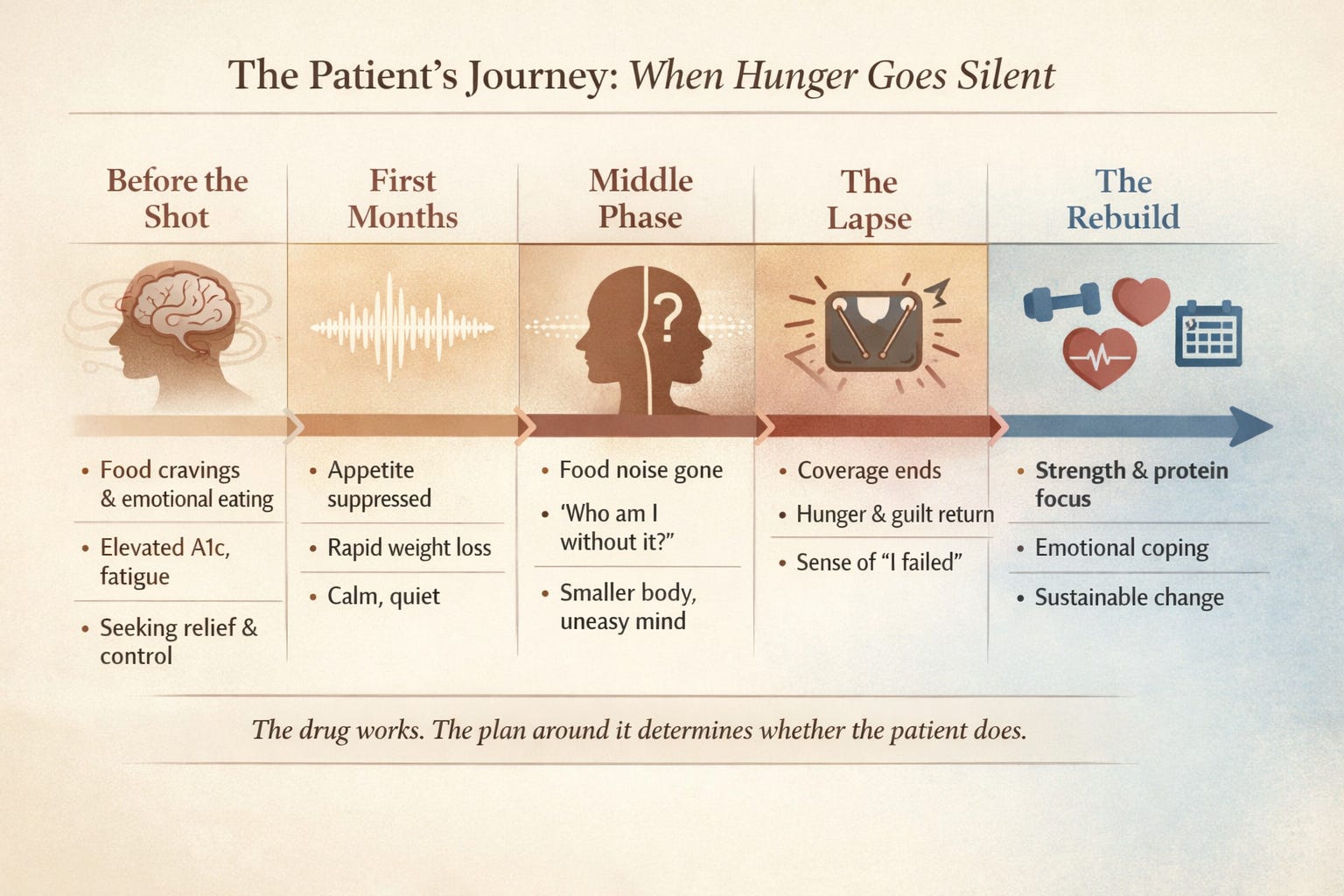
For eleven months, she told me, the noise went quiet. She used that word before I did. The constant negotiation over when she’d eat next. The low hum of food thoughts she’d carried since her twenties. Gone.
She didn’t miss the forty pounds nearly as much as she missed the silence.
She is not the only patient who has credited this drug for a quiet it never explained.
The Weight We Don’t Measure
A man in my practice lost forty pounds in five months. He celebrated the number before he came back to see me. A quarter of that weight was muscle.
No one had measured his muscle mass before he started, so no one could tell him what he was trading away while the scale kept dropping. When I finally checked his body composition and showed him the split between what he lost and what he thought he lost, he went quiet in a different way.
“I thought I was getting healthier the whole time,” he said.
He had gotten thinner.
Those are not always the same sentence.
Muscle is not vanity tissue. It determines how well he will walk at seventy, how well he clears glucose at fifty, whether a fall at eighty ends in a bruise or a fracture. Losing a quarter of forty pounds as muscle is not a cosmetic footnote. It is a silent decision—made by a drug and an unmonitored deficit—about what kind of body he will inhabit in twenty years.
A decision no one asked him to make.
The Appetite That Disappears Too Well
Another patient has not eaten enough protein in eight months to maintain the body she has left. No one told her that appetite suppression this strong requires a deliberate plan to eat against it—not simply less of everything.
She does not lack discipline.
She lacks a target no one gave her, for a problem no one named.
The drug changes what the body is asking for today.
It does not tell you what the body was asking for the thirty years before that.
That is the split.
Good labs. Bad life. And there’s a reason.
What Food Noise Was Doing All Along
Food noise that runs for decades does not appear out of nowhere. Somewhere in that span, it was doing something—regulating a low-grade anxiety that had nowhere else to go, filling a specific kind of evening silence, giving a pair of hands something to manage while a marriage, a job, a grief needed managing and food was the only variable within reach.
The receptors GLP‑1 drugs quiet are neighbors to the brain’s reward circuitry. Appetite and dopamine-linked craving share real estate. Turning down one can turn down the other. For a while, that feels like relief instead of erasure.
But quieting a signal chemically is not the same as resolving whatever built it over thirty years. The signal returns the moment the chemistry stops.
It returned for her at month eleven, when her coverage lapsed and the noise came back like a light switch—and she mistook a gap in her insurance plan for a moral failure.
She wasn’t confused.
She was reading the only explanation anyone had offered her, which was none.
What Changes When We Treat This as Data
When clinicians take this seriously—not as a footnote but as data—the prescription doesn’t change. Everything around it does.
It starts with a body composition scan, not just a weight, so muscle has a number attached to it before anything is lost—a number that can be defended later instead of guessed at.
It continues with a protein target that sounds almost aggressive, delivered on day one, because appetite has been flattened and eating on purpose now takes effort the drug was supposed to remove.
It includes a direct conversation about resistance training—not as an aesthetic add-on, but as the only intervention that tells the body which tissue to keep while the deficit runs.
And it means asking, before the drug ever starts, a question most intake forms don’t have a field for:
What has this noise been doing for you—and what do you expect to feel in the week it goes quiet?
Some patients answer immediately.
Some need a minute.
Either way, the answer belongs in the chart, not the margins.
It also means saying the uncomfortable part out loud at the first visit, not the eleventh: this drug is expensive, coverage is unstable, and if it lapses, the body does not gently return to baseline. It defends the weight it lost, and it defends it hard.
A plan for that month should exist before that month arrives—not be improvised inside it, in a patient’s private verdict that she is the one who failed.
The Plan Was the Problem
None of this is a cure. It isn’t even a protocol. It is a different way of looking at the same drug.
The prescription doesn’t change.
What surrounds it does.
She is back on the medication now, through a different channel. The forty pounds are coming off again—more slowly this time, with a protein target and a scale that measures more than weight.
Nothing about her chemistry changed between the first round and this one.
What changed was the question I asked before writing the prescription.
She was not the failure.
The plan was.
Follow a physician-led exploration of the hungers we don’t talk about—metabolic, emotional, and existential. Subscribe for clinical stories and tools that actually help
More From Healing The Split: Life Beyond Labs Series
Life Beyond Labs: What Your Doctor Missed (But Your Body Didn’t)
I’m an MD. Her Leaky Gut Wasn’t a Gut Problem — It Was a Life Problem.
Dr. Shiv Kumar Goel, MD, is an internal medicine physician in San Antonio, Texas, trained at Mount Sinai, and the founder of Prime Vitality Care. He is the author of the forthcoming book The Unread Life.
Dr. Goel believes that medicine at its best is an act of recognition — helping patients return not just to health, but to themselves. He lives and practices in San Antonio, Texas.
All names and identifying information have been modified to protect patient privacy.
Wonderful and timely post! I hope it reaches people interested in this topic.