


William did not come in to talk about his heart.
He came for a men’s-health visit — erectile dysfunction, some fatigue, nothing dramatic. He was 55, stressed, tired, and quietly worried that he no longer felt like himself.
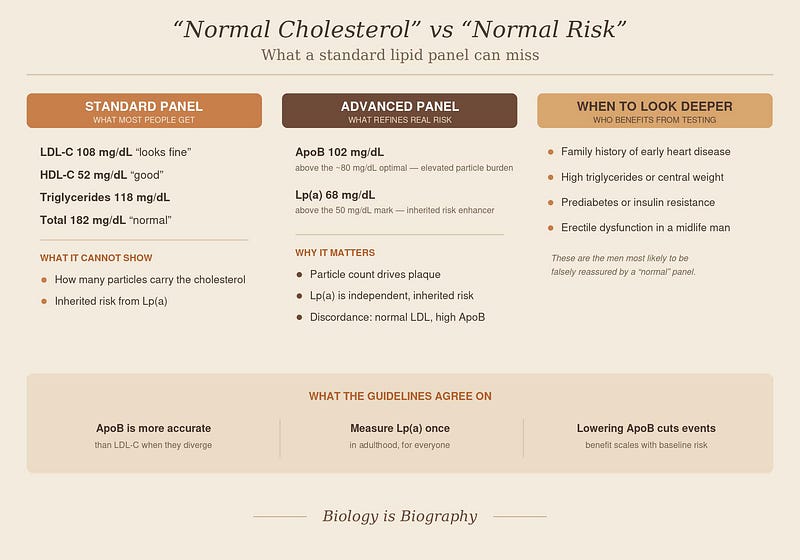
His primary care doctor had recently told him his cholesterol looked normal and his risk was low. He believed it. His numbers looked fine: LDL-C 108 mg/dL, HDL-C 52 mg/dL, triglycerides 118 mg/dL, total cholesterol 182 mg/dL.
But in midlife men, erectile dysfunction is often an early vascular clue. Men with ED carry higher future rates of cardiovascular disease, stroke, and death than men without it (2019 meta-analysis; Circulation: Outcomes analysis). None of that made him a cardiac patient. It did mean the routine panel had left the real question open.
So we looked further, at two markers that refine risk when a standard panel comes up short (2026 ACC/AHA dyslipidemia guideline).
Erectile Dysfunction Is Often Vascular Data, Not Just “Performance”
When a midlife man arrives with erectile dysfunction, the system tends to file it as a local problem — performance, mood, testosterone. The cohort data argue otherwise. Across prospective studies, men with ED run a higher future risk of cardiovascular events, coronary heart disease, stroke, and death, even after adjusting for the usual risk factors, with relative risks commonly between 1.3 and 1.6 for major outcomes (prospective cohort analyses; umbrella reviews). ED tends to arrive early, ahead of an event, not after it (narrative reviews).
The signal is strongest in William’s group. Risk runs higher in intermediate-risk men and in younger men in their 40s and 50s — the very men most likely to be reassured by a normal cholesterol and a quick calculator (mortality-focused meta-analysis). For them, ED is often the first sign the endothelium is falling behind, years before a conventional event.
That reshapes what an ED visit is for. A man in his 50s with new erectile dysfunction, central weight gain, and a family history of early heart disease deserves more than a phosphodiesterase inhibitor and a testosterone level. He deserves an honest cardiovascular look: blood pressure, fasting glucose and insulin, ApoB and Lp(a), and, in the right case, a coronary calcium score (advanced lipoprotein markers).
Not every case of ED needs a cardiac workup. But in a midlife man, it should stop being filed as a purely local complaint when his vascular system may be telling the truth first.
Why “Normal Cholesterol” Can Mislead
Cholesterol does not move through the blood on its own. It rides inside lipoprotein particles — and in many people, the number of atherogenic particles predicts arterial risk better than the cholesterol concentration does. A 2025 systematic review of discordance studies put ApoB ahead of both LDL-C and non-HDL-C as a risk marker (2025 systematic review).
LDL-C tells you how much cholesterol sits inside LDL particles. ApoB estimates how many atherogenic particles are carrying it. When the two agree, the standard panel works. When they diverge, the panel can read reassuring while particle burden runs high (recent discordance analyses).
Two men can share an LDL-C. One carries it in relatively few particles; the other spreads it across many more, often alongside insulin resistance or higher triglycerides. The cholesterol number matches. The arterial exposure does not.
So the sharper question is not whether your cholesterol is normal. It is how many atherogenic particles you carry, and what you inherited.
What ApoB and Lp(a) Add
Cholesterol is not the villain. It builds cell membranes, steroid hormones, bile acids, vitamin D, and the structure of nerves. Lipid therapy is not trying to erase it. It is trying to lower the number of ApoB-containing particles that can lodge in the artery wall (current dyslipidemia guidance).
Every atherogenic particle — LDL and VLDL remnants alike — carries a single apolipoprotein B. So ApoB counts the particles most able to do damage. LDL-C is the cholesterol in circulation; ApoB is how many potentially atherogenic vehicles are on the road.
William’s ApoB came back at 102 mg/dL — more particle burden than his routine panel implied, and above the roughly 80 mg/dL considered optimal for a man carrying added cardiovascular risk. His LDL-C looked acceptable. His particle count was not.
Then there was Lp(a), or lipoprotein(a). It is largely inherited, stays stable across life, and never appears on a standard panel unless someone asks for it. William’s measured 68 mg/dL, above the 50 mg/dL mark used to flag elevated risk. Guidelines now support measuring it once in adulthood, because it sharpens risk in ways nothing else on the panel can (ACC; AHA Lp(a) initiative).
His cholesterol panel read reassuring. His risk picture did not.
How to Actually Use ApoB and Lp(a)
Advanced lipids earn their place only when they change the decision in the room.
ApoB matters most when the story hints at discordance — a borderline LDL-C paired with higher triglycerides, central weight, prediabetes, or a strong family history of premature heart disease. In those patients, particle number and cholesterol concentration have often parted ways, and an ApoB moves the risk from uncertain to actionable (ApoB discordance literature).
What you do with it depends on context. For primary prevention without known disease, current guidelines set LDL-C goals under 100 mg/dL across low-to-intermediate PREVENT risk, and under 70 mg/dL at high risk. ApoB refines those calls, flagging people whose particle burden outruns their LDL-C, especially at an ApoB of 120 mg/dL or higher, or when several risk enhancers cluster (2026 multisociety guideline summary).
Lp(a) works differently. You measure it once, not repeatedly (National Lipid Association summary). An elevated level raises baseline risk for atherosclerotic events and aortic valve disease, argues for tighter LDL-C and ApoB targets, and justifies screening across the family, since the trait is inherited.
A borderline-risk man with a strong family history of early heart attack and a high Lp(a) is not the same patient as one with identical calculated risk and a normal Lp(a). In the first, the threshold to start a moderate-intensity statin, tighten blood pressure, and push harder on lifestyle is easier to cross.
For patients, the move is simple: if the numbers and the family story do not match, ask whether ApoB and Lp(a) have ever been checked. Your biology may be carrying information the basic panel never recorded.
What the Evidence Shows
Three points hold up.
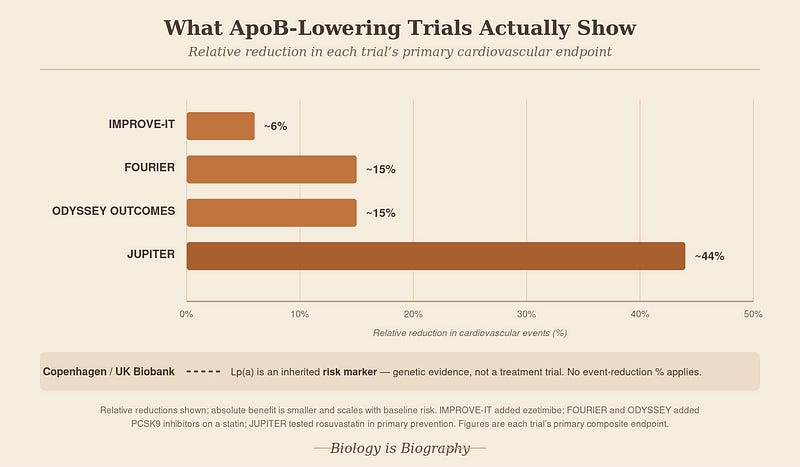
ApoB catches risk that LDL-C misses when the two diverge, and in that situation it is the more accurate marker. Elevated Lp(a) is not a lab curiosity — it is an independent, causal driver of atherosclerotic disease and aortic valve disease, which is why guidelines now call for measuring it once in every adult. And lowering ApoB-containing lipoproteins reduces events in the right patients, particularly higher-risk people already on standard therapy (current guideline summaries).
None of that means every person with a normal LDL-C and a high ApoB needs aggressive treatment tomorrow. In primary prevention, baseline risk still governs. The USPSTF recommends a statin for adults 40 to 75 with at least one risk factor and a 10-year risk of 10% or more, and a more selective approach between 7.5% and 10% (USPSTF recommendation).
A normal panel can hide real risk, and treatment intensity still has to fit the whole patient. Both are true.
How the Guidelines Think About “Borderline” Risk
For people without known heart disease, the hard calls sit in the middle — not the low-risk 25-year-old or the high-risk 68-year-old, but the 45-year-old whose cholesterol looks fine on paper and whose calculator says “borderline.”
The USPSTF keeps it simple: for adults 40 to 75 without cardiovascular disease, a statin when there is at least one risk factor and a 10-year risk of 10% or more, and a more selective approach from 7.5% to 10%. Past 76, the evidence runs out (USPSTF recommendation).
The 2026 ACC/AHA multisociety guideline uses the newer PREVENT equations instead of the older pooled cohort equations, and layers risk enhancers on top (2026 guideline press release). PREVENT gives 10-year and 30-year estimates for adults 30 to 79 and sorts risk into low, borderline, intermediate, or high.
The enhancers tilt the call: family history of premature disease, chronic inflammation, high triglycerides, metabolic dysfunction, kidney disease, high ApoB, and elevated Lp(a).
Take a man at borderline or intermediate PREVENT risk who also carries a high Lp(a), a higher ApoB, central weight, and a sibling who had a heart attack at 52. The guideline frame supports treating him earlier and more assertively — a statin, tighter lipid targets, and often a coronary calcium score to see whether atherosclerosis is already underway (JAMA Cardiology editorial).
The rule is not that everyone at 7.5% gets a statin. It is that baseline risk, risk enhancers, family story, and advanced lipids belong in one conversation. When they line up toward higher risk, waiting for the first event stops being a neutral choice.
Why the Same “Normal” Doesn’t Mean the Same Thing
If two people can share an LDL-C and not a risk, the reasons are worth naming.
Insulin resistance, visceral fat, and higher triglycerides push the body toward more atherogenic particles without moving LDL-C much. Genetics shape both Lp(a) and the tendency toward discordance. Even the measurement matters — LDL-C is usually calculated, not measured directly, and the estimate drifts when triglycerides run high (ApoB review literature).
Your neighbor’s normal panel is not a verdict on your arteries.
It is also why both halves of modern medicine miss this. Routine care underuses ApoB, so hidden risk goes unmeasured. Aggressive longevity and functional practices overcorrect, treating every off-range biomarker as a disease. Neither reflex helps. Better measurement, then better interpretation, does.
HDL shows the trap. A low HDL is a useful marker, but raising it with drugs has not reliably reduced cardiovascular events in trials (systematic review and meta-regression). Low HDL is a reason to look upstream, not a target to chase.
Advanced Lipids Are Tools, Not Identity Labels
Advanced lipids can clarify risk. They can also be abused.
Conventional care errs by omission — never ordering ApoB or Lp(a) in the very patients whose stories point straight at discordance or inherited risk. The wellness and longevity world errs the other way, ordering enormous panels and treating every flagged line as its own disease.
The pattern is familiar. A patient arrives having had LDL particle number, oxidized LDL, Lp-PLA2, small dense LDL, and a fistful of proprietary scores measured. He has been told everything is wrong and put on a stack of supplements, a restrictive diet, and a schedule of expensive repeat testing. Strip it back, and the two signals that mattered were a high ApoB and a high Lp(a) — reachable with far fewer tests, and enough to guide real decisions about statins, lifestyle, and family screening (ApoB; Lp(a) consensus guidance).
The cost of over-testing is not only money. It turns biology into identity. Patients start describing themselves as oxidized-LDL types or particle-number types, even where those markers were never tied to outcomes the way ApoB and Lp(a) are. Risk becomes a brand. The nervous system burns its energy tracking panel changes instead of tracking whether the person is actually moving toward safer ground.
The honest use of advanced lipids is narrower. Order ApoB and Lp(a) when they will change a decision. Read them against guideline thresholds, family history, and the body in front of you. Then fold them back into the question that governs the rest of care: what, in this particular person, is happening that the standard instruments have only half seen?
What I Tell Patients in Clinic
When the routine panel looks acceptable but the picture does not, two measurements help: ApoB and Lp(a). ApoB estimates current particle burden. Lp(a) reveals inherited risk the standard panel will never show, and once in adulthood is enough (current guidance).
It earns its place when the numbers do not fit the person — a family history of early heart disease, central weight gain, prediabetes, higher triglycerides, or a vascular clue like midlife ED. There, a normal LDL-C is not the end of the conversation. It is where the better question starts.
When treatment is warranted, the answer is not always the most aggressive drug on the shelf. In primary prevention, baseline risk, tolerance, and preference still count, and shared decision-making belongs there.
William understood the science. He understood that his routine panel had not told the whole story. He still chose to wait, and I did not push him.
A more accurate risk picture does not force every patient to the same decision. It does force us to stop mistaking normal cholesterol for a finished cardiovascular assessment.
Questions to Bring Into the Visit
If your cholesterol looks fine but something still nags at you, these are quetions worth bringing to your next visit —
“My cholesterol came back normal, so how do you actually know how likely I am to have a heart problem someday?” This nudges your doctor toward a real risk estimate with tools like PREVENT instead of a rough guess.
“Should we check my ApoB? With my triglycerides, my weight, and heart disease in my family, I’m not sure the regular cholesterol test tells the whole story.” ApoB can show particle risk a standard panel misses.
“Has anyone ever checked my Lp(a)? Heart trouble runs in my family, and I heard it’s a one-time test.” Current guidance supports checking it once in adulthood.
“If I’m kind of on the fence, what would make you lean toward starting a statin — and what would make you say let’s wait?” The USPSTF thresholds are a good anchor for that talk.
“Would one of those heart calcium scans actually tell us whether I need medication right now?” In in-between cases, the score often moves the decision one way or the other.
“Besides pills, what could I actually do that would move my numbers — my ApoB, my blood pressure, my weight?”
“If my ED might be an early warning for my heart, how do we take it seriously without going overboard on tests?”
That last one holds the ground the evidence supports: neither brushing the symptom off nor turning it into a sales pitch, but reading it as data.
If the panel looks fine but the picture does not, the goal is not more tests. It is the right two — and a more honest conversation about what they mean.
Enjoyed this breakdown?
The Life Beyond Labs series examines one health question at a time — without the hype in either direction.
For deeper clinical essays on what medicine often misses and what patients actually feel, subscribe to my Substack: Healing the Split
I publish there first, for readers who want more than a test result.
About the Author
Dr. Shiv Kumar Goel, MD, is an internal medicine physician in San Antonio, Texas, trained at Mount Sinai, and the founder of Prime Vitality Care. He is the author of the forthcoming book The Unread Life.
He is the author of What Medicine Misses and Patients Feel (forthcoming) — a clinically grounded, human account of the gap between what standard medicine can see and what patients actually experience.
To follow his work: drshivgoel.com To reach him directly: [email protected]
Patient details including name, age, timeline, and identifying circumstances have been changed. William is a composite drawn from clinical encounters over many years of practice. No individual patient is depicted or identifiable.