

During my anesthesia residency in Delhi, I read a description I still can’t shake.
Before modern anesthesia, surgery meant enduring it. Herbs, alcohol, cold, compression, intoxication—anything to blunt consciousness enough to cut. Some patients died from the attempt before the procedure even began. And many survived the anesthetic only to face the knife fully awake.
That wasn’t a rare historical horror. It was the ordinary condition of being sick in a body that needed to be opened.
For twenty years, that image has followed me. Not as a clinical curiosity, but as a reminder of how thin the membrane is between what medicine can do now and what it couldn’t do just a few generations ago. We crossed that line recently enough that the memory still echoes.
The First Healers
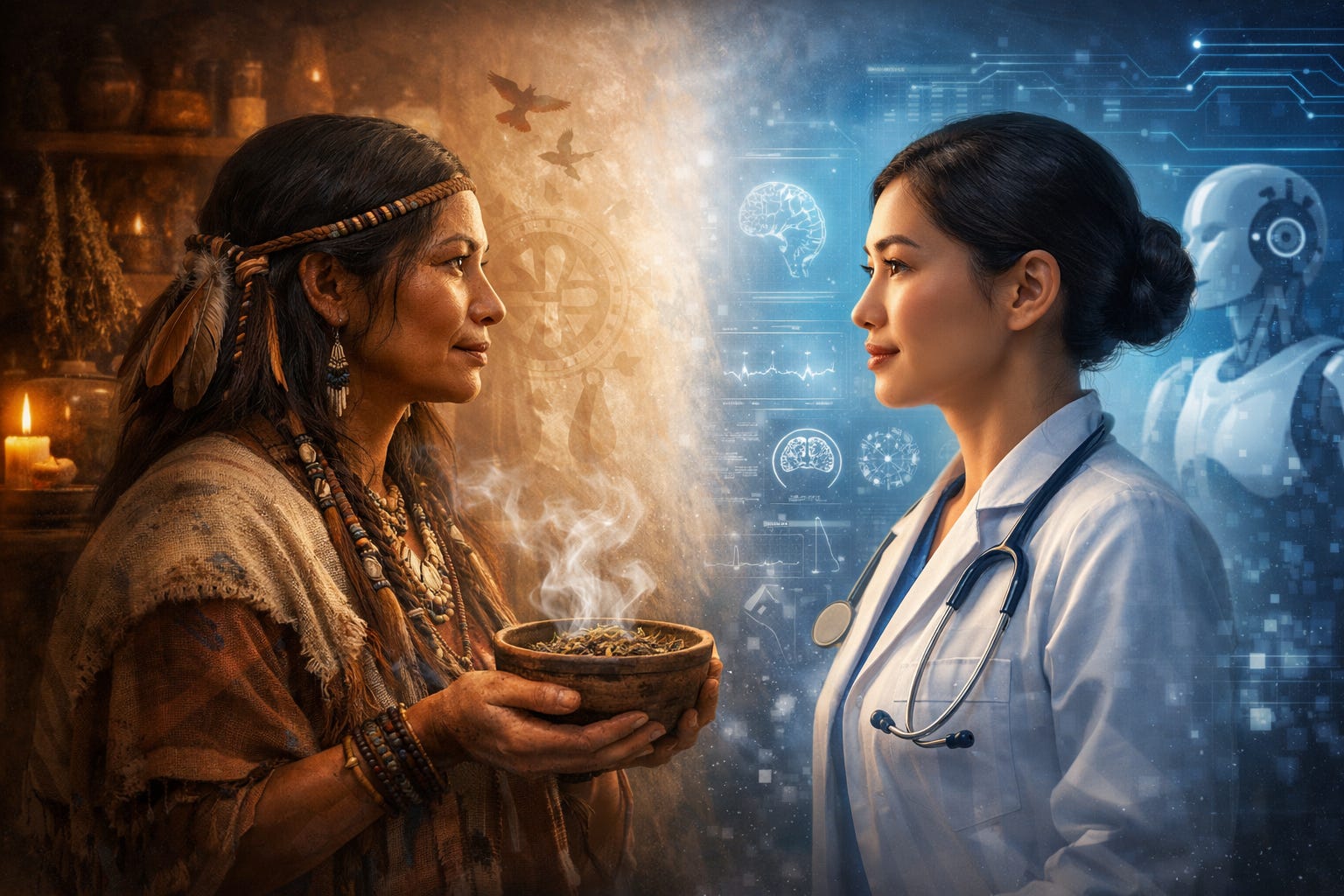
Long before the white coat, there was the medicine woman.
She was the midwife, the herbalist, the watcher of fevers, the keeper of remedies. Healing wasn’t divided into departments. Birth, grief, fertility, pain, sleep, community—these lived in the same circle of care. Illness was never separated from the life surrounding it: the family, the season, the fear, the loss.
We know some of their names. Peseshet, in Egypt’s Old Kingdom, nearly 4,500 years ago, held a title that translates to “overseer of female physicians.” She didn’t just practice medicine; she supervised other women who did.
Agnodice of Athens—whether historical or partly myth—was said to have disguised herself as a man to practice medicine because women weren’t permitted to. The story is symbolic of something that was true almost everywhere: women stood at the center of healing while being systematically kept outside its institutions.
Their medicine had limits. It was entangled with superstition, and it could not defend against the infections, cancers, or cardiac events we now routinely treat. People died of conditions we would catch on a Tuesday afternoon.
But their medicine also held something ours has largely misplaced: the understanding that illness was never only biological. It was emotional, familial, spiritual, environmental. The sick body lived inside a life, and the life was part of the diagnosis.
The Great Acceleration
Then medicine sped up—and it has never slowed down.
In 1847, Semmelweis showed that handwashing cut maternal deaths by more than 80%. His colleagues rejected him.
A few decades later, Lister brought Pasteur’s germ theory into the operating room, and antisepsis changed what surgery could survive.
In 1928, Fleming noticed penicillin growing in a petri dish he’d forgotten to clean. By the 1940s, a bacterial infection had gone from a likely death sentence to a ten‑day prescription.
Vaccines, transplant medicine, the ICU, imaging, genomics, robotic surgery, the sensor on your wrist—this is arguably the most compressed run of technical advancement in the history of any profession.
We bought years with it. Life expectancy in the U.S. was around 47 in 1900. By 2019, it was past 78.
The anesthesia bay where I trained—continuous oxygen monitoring, end‑tidal CO₂, real‑time depth‑of‑sedation tracking—would have looked like science fiction to surgeons working before the first public ether demonstration in 1846.
That is a civilization‑scale shift in less than a human lifespan.
What the Acceleration Cost
Every transformation sends a bill.
As medicine grew more powerful, the room where it happened grew smaller. Faster. More instrument‑dependent. The average physician visit in the U.S. now runs about 18 minutes.
The family that shaped the illness. The community that held the patient. The childhood buried in the history.
None of that fits neatly into a note. It isn’t coded. It isn’t reimbursed. So the encounter was built around what could be measured—and quietly stopped being built to hold the rest.
The result is a patient every clinician recognizes: thoroughly worked up, composed, and still somehow getting worse. Labs normal. Scans clean. And underneath it all, a body running on chronic stress hormones, a circadian rhythm that never resets, a nervous system on alert since childhood—none of which shows up on a standard panel, even though the biology is now well documented.
Nobody decided to remove presence from medicine. We optimized for speed, throughput, measurable outcomes. Presence was simply what got left on the floor.
The AI Physician, and the Question Beneath It
Now medicine is accelerating again.
AI systems can read a retinal photograph and catch diabetic retinopathy with ophthalmologist‑level accuracy. They can detect the early shape of sepsis in vital signs before a patient meets a single official criterion. They can flag readmission risk or medication gaps at a scale no human could match.
This isn’t speculative. It’s already running in radiology departments, ERs, and chronic disease programs—including several here in San Antonio.
So the real question was never whether AI belongs in medicine. It does. The diagnostic power is real, and the lives it will save are real.
The question is what remains for the human sitting across from the patient—the part the algorithm cannot touch.
The algorithm will find the abnormal value. It will not know the fatigue is grief. It will not connect the insomnia to the marriage. It will not notice the chest pain began the week the patient’s father died. It cannot ask, When did your body first stop feeling safe? And it cannot hold the silence afterward.
The physician of the next twenty years will need to be bilingual: fluent in the data, and fluent in the human being producing it. Not one instead of the other. Both, in the same fifteen minutes.
What the History Is Trying to Tell Us
I don’t see the arc from medicine woman to AI physician as a straight line of progress. It’s a pattern that keeps repeating: every leap in technical power carries the same hidden risk—that the instrument becomes the whole inquiry.
Germ theory freed medicine from superstition and gave us the pathogen. It also made it easier to ignore the terrain the pathogen landed in.
The randomized controlled trial gave us evidence‑based medicine. It also cost us the individual patient who never looked like the trial population.
The diagnostic panel gave us the abnormality. It also cost us, far too often, the story.
AI is simply the next version of that same bargain—and, if we’re paying attention, the next chance not to make the same trade.
Here in San Antonio, the history of medicine isn’t only technological. It’s a history of healers—physicians, nurses, community health workers, promotoras, curanderas—who carried presence alongside knowledge. The curandera tradition is, in a real sense, an unbroken thread back to the earliest healers: holistic, embedded in community, attentive to body, emotion, and spirit at once.
That combination—presence and knowledge, story and data—isn’t a relic. It’s the standard our profession has quietly aspired to all along, even in the decades our own structures made it hard to reach.
The oldest medicine knew something the newest medicine is relearning.
A sick body lives inside a story. And the story is always part of the diagnosis.
A longer, footnoted version of this piece appears in this month’s San Antonio Medicine.
Read more from Healing the Split
If this piece touched something your body already knew, you may find resonance in these other stories from the archive. Each one sits where medicine, memory, biography, and healing overlap.
The Body Remembers What the Mind Was Never Told — on what the body carries before language, diagnoses, or lab ranges catch up.
Good Labs, Bad Life — when the chart says “normal” but the lived experience does not.
The Unsent Sentence — the words your nervous system has been saying for years that never made it into a medical note.
The Three-Generation Contract — how illness and healing often begin long before your own birth and continue long after your own labs.
Dr. Shiv Kumar Goel is a board‑certified internist practicing functional and integrative medicine in San Antonio, Texas, through Prime Vitality Care. He is writing Healing the Split: When Your Biology Is Fighting Your Biography.